
Contact Us Today
+1(908) 645-1000
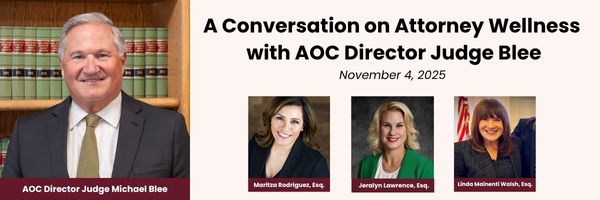
The legal profession is confronting an uncomfortable truth: it is in crisis. Long hours, unrelenting pressure, and a culture that rewards exhaustion have left many lawyers emotionally drained — and New Jersey is leading a growing movement to change that.
At a recent discussion hosted by the New Jersey State Bar Association’s Lawyer Wellbeing Committee, Acting Administrative Director of the Courts Judge Michael J. Blee joined Jeralyn Lawrence, Esq., Maritza Rodriguez, Esq. and Linda Mainenti Walsh, Esq., to talk about the state of attorney wellness and the judiciary’s role in creating a healthier profession.
Their message was clear — the status quo is unsustainable.

“We are a profession in crisis,” Lawrence said, opening the program with stark data from the Putting Lawyers First Task Force, an initiative she launched during her NJSBA presidency. “The pace of our practice is not sustainable. We need more grace, more humanity, and a culture change.”
The numbers she shared were alarming. Nearly half of the 1,637 New Jersey attorneys surveyed reported burnout. More than two-thirds said they experience anxiety, and over half reported alcohol misuse. 10% (164 lawyers) admitted to having suicidal thoughts.
“We glorify busyness instead of balance and exhaustion instead of sustainability,” Lawrence said. “That mindset is literally making us sick.”
The report identified the roots of the problem: an “always on” culture that demands 24/7 availability, economic pressures, adversarial work environments, and the stigma that prevents lawyers from seeking help. “The question is no longer whether we have a wellness problem,” Lawrence said. “We know we do. The question is what we’re willing to do about it.”

For Judge Blee, who began his career as a solo practitioner before joining the bench, the issue is both professional and personal.
“At every stop, I talk about wellness because the survey also showed that not only our lawyers are suffering but we as judges, who are lawyers, are also suffering.”
Since his appointment as Acting Administrative Director in April 2025, Blee has made wellness a focal point of his leadership. “We can’t care for others if we can’t care for ourself first. So we need to be right to make other people right. We need to come together to try to help each other, to see if somebody’s struggling, try to get them help.”
Blee outlined a series of initiatives that reflect a more collaborative approach between the bench and the bar.

The judiciary now authorizes court personnel, attorneys, and judges to make confidential referrals to the New Jersey Lawyers Assistance Program (NJLAP). Colleagues who notice troubling behavior can refer someone for support without breaching privacy.
One of the most celebrated changes is the reform of Question 12B on the Character and Fitness application, which is part of the bar application, that formerly asked applicants about mental health conditions.
“That question had a chilling effect,” Lawrence said. “Law students told us they were afraid to seek therapy because they knew they’d have to disclose it later.”
With input from the bar, the judiciary rewrote the question to focus on conduct rather than diagnosis — a small but significant step toward ending stigma. “The third-party referral – you make the call, you can keep it anonymous. You provide the individual’s name, a little bit of background, and away it goes. Understand, though, that’s the last contact you’ll have, because what we’ve heard from our committees and the surveys is that the lawyers are really concerned about confidentiality, again, because of the stigma,” Blee stated.
As a former solo practitioner, Blee knows firsthand how important planning can be. “Starting September 25th, attorneys in private practice will respond to questions about succession planning status and annual registration.”
Lawrence praised the judiciary for its collaborative approach. “I think it’s a wonderful example of the collaboration of the bench and the bar, and so the succession planning came out as a recommendation for the Supreme Court Wellbeing Committee, and there was a lot of talk about whether it should be mandatory or not and the court was extremely receptive to the bar pushing back on it being mandatory.
For the first time, every assignment judge in New Jersey now addresses wellness during annual State of the Judiciary meetings — a simple but powerful change initiated by Blee.
“I think I’ve been practicing close to 30 years, and the first time was Judge Shanahan, he was our assignment judge, and, you know, to hear him speak about wellness, it was just one of those moments, that you feel like you arrived,” Lawrence said.
Courthouses have also begun hosting wellness-focused activities — from CLEs and mindfulness sessions to acupuncture pop-ups — and providing information about confidential support programs.
The Supreme Court’s Wellness Committee, which includes Blee and Lawrence, is reviewing the $2,000 inactive status fee for attorneys who take leave due to disability or mental health needs.
“You wonder why an attorney who is struggling, who has to make a difficult decision that could affect his or her family, by going on disability inactive status, needs to pay $2,000. So we’re working on that,” Blee said.

Despite the progress, challenges remain. During the question and answer, solo practitioner Jacqueline O’Donnell, Esq. shared her story of being denied a trial adjournment to accommodate a long-planned vacation. She described logging into court proceedings from a café in Turkey rather than risk being deemed unprepared.
Her account struck a chord with everyone in the room.
Blee’s response was direct. “You were treated wrongly, that’s just wrong.” he told her. “So what I would ask you to do, if you could shoot me an email with a little bit more, docket number, dates, names. I will address it.”
He acknowledged the difficult balance between keeping cases moving and respecting attorneys’ personal lives. Jeralyn was in agreement and stated, “We all want efficiency, but not at the expense of humanity.”

As the discussion came to a close, both Lawrence and Blee reflected on the shared responsibility to prioritize well-being.
“This is the month of gratitude, as we get ready to celebrate Thanksgiving, and I just want to say how grateful I am, one, for everybody on the screen, two, for some of us that are on the tail ends of our career to be open to these concepts – to want to help our brothers and sisters in this profession,” Blee said.
Lawrence echoed that sentiment. “Wellness isn’t a trend. It’s the foundation of a sustainable profession,” she said. “When we put lawyers first, we strengthen the entire justice system.”
The message was unmistakable: wellness is no longer optional. It is a professional duty — one that requires empathy, awareness, and systemic reform.
New Jersey’s judiciary and bar are modeling what that change looks like: collaboration over criticism, progress over perfection, and a collective commitment to ensuring that those who serve justice can do so without losing themselves in the process.
To learn more about the Putting Lawyers Task Force and Attorney Wellness, visit lawlawfirm.com/putting-lawyers-first/ and lawlawfirm.com/wellness.
Visit njcourts.gov for more information and resources.




The Super Lawyers List is issued by Thompson Reuters. A description of the selection methodology can be found here. Visit here for the selection methodology for Best Lawyers. A description of the Martindale-Hubbell AV Preeminent® status selection methodology can be found here. The New Jersey Law Journal Best Of methodology, can be found here. No aspect of this advertisement has been approved by the Supreme Court of New Jersey. A description of the Martindale-Hubbell Peer Rating selection methodology can be found here.

© 2026 Lawrence Law Firm.
All rights reserved | Attorney Advertising